
Options Masterclass, Module 1: Foundations That Keep You From Blowing Up
Learn the contract mechanics, DTE choices, and account-killer mistakes so you stop gambling with options and start using them as a professional risk engine.

This module is for traders who are done gambling on cheap OTM calls and want a structured options foundation they can actually build on
What Are Options
The options market has become the most powerful tool for traders who want asymmetric returns, defined risk, and the ability to express a precise edge in any market environment.
The problem is that most traders treat options like lottery tickets, not precision instruments, and they end up bleeding out on theta, getting crushed by IV, or blowing up accounts chasing home runs. Module 1 of The Complete Options Trading Masterclass is where that changes.
In this first module, you’ll build a real foundation:
How contracts actually work, why “moneyness” and DTE matter more than the ticker, and the specific mistakes that quietly kill most options accounts. By the end, you’ll understand the building blocks well enough to stop gambling with options and start using them like a professional risk engine. Whether you trade directional setups, sell premium, or hedge a growing portfolio.
What you’ll learn in Module 1:
How options contracts, moneyness, and expirations actually work so you’re never guessing what you’re buying.
When LEAPS vs weeklies give you a real edge, and when they’re just an expensive or risky distraction.
Why cheap OTM “lotto” options quietly bleed accounts, and how to choose smarter strikes instead.
The 5 core mistakes that blow up most options traders before they ever get consistent.
How to start thinking about options as structured, defined risk bets, not casino tickets.
Why This Guide Matters
Options are the most flexible tool in the market, but most traders use them like scratch-off tickets instead of structured, risk-defined bets. Cheap OTM calls, random weeklies, and earnings gambles feel exciting, but they quietly bleed accounts dry.
This masterclass is built to fix that by giving you a clear, repeatable foundation: how options actually work, how to avoid the killer mistakes, and how to think like someone running an options business instead of chasing lotto wins.
Module 1 is your on-ramp. You’ll walk away with a concrete framework that makes every option(s) decision, from contract choice to expiration, more deliberate and less emotional.
Quick Callback: Building on the Foundation
In our issue, "Options Trading Essentials + Pro Tips," we covered the core mechanics, introduced key concepts, and shared tactical insights for immediate application. Several of you reached out asking for the promised deep dive, so here we are.
This is the guide.
I hope it will be your complete reference manual, structured to take you from foundational understanding to professional-grade execution. Whether you're swing trading earnings setups, selling premium systematically, or hedging a concentrated portfolio, you'll find actionable frameworks here.
Let's get into it.
Fundamentals Recap | The Building Blocks
What Is an Options Contract?
An options contract is a standardized agreement giving you the right (but not obligation) to buy or sell 100 shares of an underlying stock at a specified price (strike) before a specified date (expiration).
Key terminology:
Premium: The price you pay (or collect) for the option
Strike Price: The price at which you can exercise the contract
Expiration Date: When the contract expires (worthless if not ITM)
Intrinsic Value: How much the option is "in the money."
Extrinsic Value: Time value + volatility premium (the part that decays)
Moneyness: ITM, ATM, OTM
In-the-Money (ITM): Call strike is less than the stock price, Put strike is higher than the stock price.
At-the-Money (ATM): Strike ≈ stock price (highest gamma)
Out-of-the-Money (OTM): Call strike is higher than the stock price, Put strike is lower than the stock price
Critical insight: OTM options are cheap for a reason. They have a low probability of profit. ATM/ITM options cost more but have higher delta and better risk/reward for directional conviction trades.
Contract Specifications
Multiplier: 1 contract = 100 shares (so a $2.50 premium = $250 per contract)
Liquidity matters: Trade options with tight bid/ask spreads (<$0.10 for liquid names)
Open Interest: Measures existing contracts. Higher OI = better liquidity
Contract Types | Beyond Vanilla Calls and Puts
Calls
Right to buy shares at the strike price.
Long Call: Bullish directional bet, capped risk (premium paid), unlimited upside
Short Call: Bearish/neutral, collect premium, unlimited risk (unless covered)
Puts
Right to sell shares at the strike price.
Long Put: Bearish directional bet, capped risk, substantial downside profit potential
Short Put: Bullish/neutral, collect premium, risk = (strike - 0) × 100
LEAPS (Long-Term Equity Anticipation Securities)
Options with expirations 9+ months out (typically 1-2 years).
Use cases:
Stock replacement: Control 100 shares for a fraction of capital
Long-term directional conviction with lower theta decay
Diagonal spreads: Sell short-term options against LEAPS to reduce cost basis
Example: Instead of buying 100 shares of NVDA at $500 ($50,000), buy a $500 strike LEAP call 12 months out for $8,000. Same delta exposure, 84% less capital.
Weeklies (0DTE/1DTE)
Ultra-short-dated contracts expiring within days or same-day (0DTE).
Characteristics:
Extreme theta decay
High gamma risk (rapid delta changes)
Popular for day trading SPX, SPY, QQQ
Warning: 0DTE options are not for beginners. Gamma and theta accelerate dramatically in the final hours. Use them for defined, high-conviction scalps, not hope trades.
What Kills Traders’ Accounts
Mistake 1: Chasing Cheap OTM Options
"$0.50 calls? I can buy 20 contracts! If it hits, I'm rich!"
Reality: OTM options are cheap because they have low probability of profit. They decay fast (theta), require massive moves, and expire worthless 80%+ of the time.
Fix: Trade ATM or ITM options for directional plays. Better delta, lower theta drain relative to extrinsic value.
Mistake 2: Holding Through Earnings (IV Crush)
"Stock will beat and moon, my calls will print!"
Reality: Even if the stock moves 5% your direction, IV collapse can make your calls lose value.
Fix: Sell before earnings (capture IV expansion), or use spreads (lower vega exposure).
Mistake 3: Ignoring Position Sizing
"I'm super confident, so I'll risk 20% on this trade."
Reality: One bad trade wipes out weeks of gains. String together 3 losses, you're down 60%….
Fix: Risk anywhere from 1–5% per trade. Boring? Yes. Profitable long-term? Absolutely.
Mistake 4: Letting Theta Decay Kill You
Holding long options into the final 2 weeks (theta accelerates exponentially).
Reality: You lose $50/day from decay. A stock needs to move significantly just to break even.
Fix: Close or roll long options by ~21 DTE unless conviction is extreme.
Mistake 5: Revenge Trading After Losses
Lost money on a trade → immediately open a larger position to "make it back."
Reality: Emotional trading = the largest account killer. You compound losses, violate risk rules, and blow up.
Fix: After a loss, step away. Review trade, journal lesson, resume trading the next day with a clear head.
Before you move on, pick the ONE mistake you’ve made the most in the last 3 months and either journal it or drop it in the comments!
Admiting it is the first step to changing it…
Myth 1: "Options Are Gambling"
Truth: Poorly structured options trades (OTM lottery tickets, no plan) are gambling. Defined-risk spreads, hedged portfolios, and systematic premium selling are strategic tools.
Myth 2: "Selling Options = Free Money"
Truth: Selling naked options has unlimited risk. Selling spreads has defined risk but still requires discipline. Short options = short volatility = you lose big on unexpected moves.
One bad month (Oct 2024 volatility spike, random news) can wipe out 6 months of premium collection.
Myth 3: "Greeks Are Too Complicated"
Truth: You don't need a PhD…
Understand delta (direction), theta (time), vega (volatility), and you're ahead of 90% of retail traders.
What You’ve Built In Module 1 (And What’s Next)
You’ve just built what most options traders never take the time to build:
A real foundation
You understand how contracts work, why moneyness and DTE matter, the difference between LEAPS and weeklies, and the specific mistakes that quietly torch accounts.
From here, the advantage is in how you put this foundation to work. That’s where the rest of The Complete Options Trading Masterclass comes in.
Next up in Module 2: Mastering the Greeks
Up to this point, you’ve seen why traders blow up:
Ignoring time decay, misjudging probability, and getting steamrolled by volatility.
All of that lives inside the Greeks.
In Module 2 (paid), we turn delta, theta, and vega into a simple control panel so you can see, before you click “buy,” how your option will actually behave as price, time, and volatility change.
You’ll learn how to:
Use delta as a probability and risk gauge instead of a mystery number.
Stop bleeding out from theta by choosing the right DTE and structure.
Avoid IV crush and position around volatility, rather than getting run over by it.
Then Module 3: Core Strategy Playbook
Once you understand the Greeks, the next edge is pairing them with the right structure for the environment you’re trading.
Module 3 (paid) takes everything from this foundation and turns it into concrete plays: single-leg calls/puts, verticals, condors, calendars, diagonals, with clear “use this when / avoid this when” rules and real examples. You’ll know exactly which strategy fits a trending market, a choppy range, a high-IV earnings setup, or a slow grind higher.
To celebrate the season of giving Module 1 is intentionally free so you can see the difference between gambling with options and running an options playbook with defined risk. Module 1 is your foundation, and the rest of December is about stacking the full options playbook on top of it.
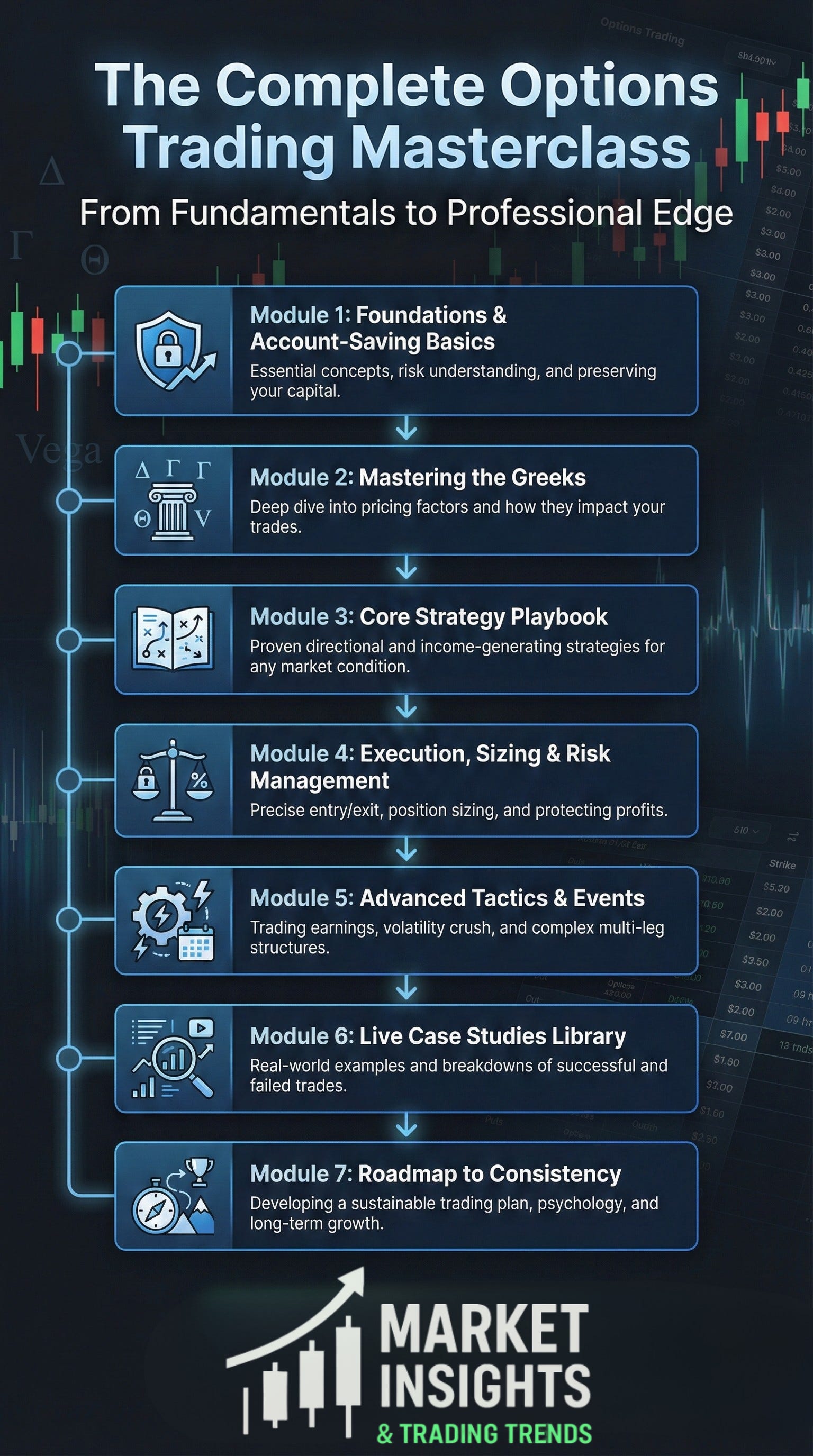
Here’s the release schedule for the rest of The Complete Options Trading Masterclass:
Friday, December 5: Module 2 – Mastering the Greeks (paid)
Tuesday, December 9: Module 3 – Core Strategy Playbook (paid)
Friday, December 12: Module 4 – Execution, Sizing & Risk Management (paid)
Tuesday, December 16: Module 5 – Advanced Tactics & Events (paid)
Friday, December 19: Module 6 – Live Case Studies Library (paid)
Tuesday, December 23: Module 7 – Roadmap to Consistency (paid)
If you’re already a paid member, you’ll get each module delivered automatically on those dates. If you’re still on the free list and want the full operating system: Greeks as your dashboard, a proven strategy playbook, execution and risk rules, advanced tactics, live case studies, and a 3–6 month roadmap… Upgrade to a paid membership to unlock Modules 2–7.
Tap the button below to get every module, all future updates, and member-only deep dives on the exact setups and strategies you can deploy in your own account.
Risk Disclosure & Disclaimer
Options trading involves substantial risk and is not suitable for all investors. The risk of loss in trading options can be substantial and, in some strategies (e.g., naked short options), unlimited. You may lose more than your initial investment.
This guide is for educational purposes only and does not constitute financial advice, investment recommendations, or a solicitation to buy or sell securities. All examples and case studies are hypothetical or for illustrative purposes. Past performance does not guarantee future results.
Before trading options:
Understand the risks, including total loss of capital
Read the Characteristics and Risks of Standardized Options (provided by your broker and available at optionsclearing.com)
Ensure you have sufficient capital, risk tolerance, and experience for the strategies you deploy
Consult with a licensed financial advisor or tax professional regarding your specific situation
Trading decisions are your responsibility. The author and "Market Insights & Trading Trends" assume no liability for losses incurred from implementing strategies discussed in this guide.
Options are complex financial instruments. If you don't fully understand a strategy, don't trade it. Paper trade first. Start small. Protect your capital.
The Closing Bell 🔔
Options got me the financial freedom to trade full-time. They've funded accounts, hedged portfolios through crashes, and delivered asymmetric winners that changed trajectories.
But they've also humbled me.
Taught me patience. Forced discipline. Made me respect risk.
The trader who masters options isn't the one who makes the biggest bet; it's the one who survives, compounds, and executes with precision over years.
You're building that skillset right now. Every trade, every loss, every journal entry; it's compounding your edge.
Welcome to the arena. Let's get to work.
— Kyle Tusing
Your editor and fellow trader
Market Insights & Trading Trends
P.S. — If this guide added value, share it with a trader who needs it. The best communities are built on shared knowledge. Let's grow this together.